Blue Sky
Smaller exploratory projects and technology R&D — the lab's pipeline for what comes next.
Alongside the main efforts on CHIME, CHORD, and CHARTS, the lab runs a rotating set of smaller R&D projects: instrument prototypes, building blocks for future arrays, and one-off experiments that test ideas worth trying. Many of these feed back into the bigger projects; some are interesting on their own.
CARAT
A small CSA-funded cubesat radio calibration source — an in-orbit reference signal designed to be visible to ground-based radio arrays for absolute beam and gain calibration.
Horizon RFI antenna

A directional, horizon-pointing antenna designed to monitor the radio-frequency interference (RFI) environment from the same line-of-sight that bleeds into a radio array's sidelobes. The aim is to use this independent RFI record to subtract or veto contamination in the main array data — cleaner spectra without sacrificing sky coverage.
Differential signal chains

Work on fully-differential analog signal chains for radio astronomy: from feed output through the LNA, filtering, and digitization. Differential signaling all the way through promises better common-mode rejection of self-generated noise and EMI in dense, RFI-sensitive arrays.
Radio DSP & correlators
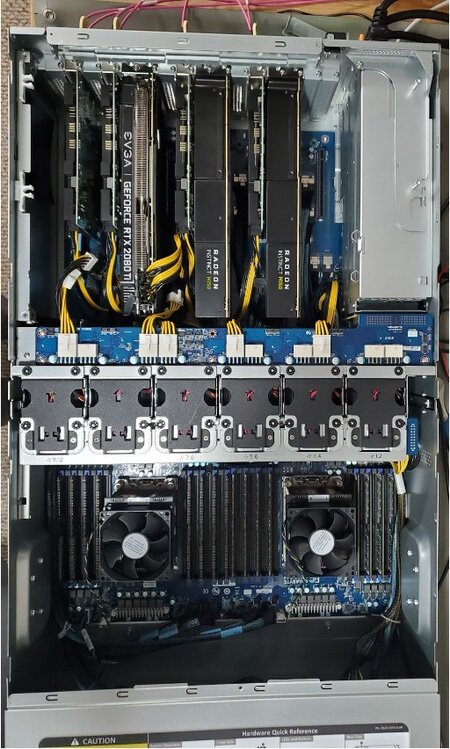
A long-running thread of work on real-time digital signal processing for radio arrays: FX-correlator engines, GPU spatial-processing pipelines, and beamforming backends. CHIME's GPU X-engine (Denman et al., 2020) came out of this lab, and several of the building blocks are reused across CHORD, CHARTS, and other projects.
Low-noise amplifiers
Custom ultra-low-noise amplifier design for the wideband feeds CHORD and CHARTS use, including differential and single-ended variants, with an eye toward pushing system temperatures as close to the sky-limited regime as possible.